
Over 200 scientists, startup founders and partners in government and industry gathered at Uris Auditorium on April 23 for the 2026 BioInnovate Conference. The event, hosted by BioVenture eLab, part of Weill Cornell Medicine Enterprise Innovation, celebrates the growing ecosystem that turns scientific discovery into scalable healthcare solutions. Speakers and panelists discussed topics ranging from AI in clinical trials to reshoring domestic drug discovery and manufacturing.
Dr. Lisa Placanica, senior managing director of the Center for Technology Licensing at Weill Cornell Medicine, called the event a “convening of the village” and “mixing of the entire ecosystem.” She noted that concerted efforts by Enterprise Innovation and its collaborators led to the launch of 43 active startups that were founded on Weill Cornell technologies. These companies, with nearly half based in New York City, have collectively raised over $2 billion in financing. “We're a strong believer in building our local ecosystem and making New York City a leading biotech hub,” she said.
“BioInnovate connects our Weill Cornell Medicine researchers, clinicians and innovators with investors, entrepreneurs and industry partners to translate breakthroughs in biotech, health and medicine into real-world impact for patients and society,” Dr. Krystyn J. Van Vliet, vice president for innovation and external engagement strategy at Cornell University, reiterated the mission of the conference and acknowledged contributions by conference organizer, BioVenture eLab Director Loren Busby, and participating biotech leaders.
Startups Resulting From a Robust Ecosystem
Based on research conducted by the late Dr. Timothy K. Vartanian, who served as a professor of neuroscience at the Feil Family Brain and Mind Research Institute, Astoria Biologica presented its first-in-class therapy candidate for multiple sclerosis, a disease with both inflammatory and neurodegenerative components. CEO Dr. Rick Rudick described how it could work earlier in the disease pathway than current drugs by targeting epsilon toxin, preventing it from injuring the brain.
"We think it has the potential to be completely non-toxic, because this drug won't interfere with the immune system. It may also expand the market by treating the progressive phase of MS, which current drugs don't treat," he said. "If true, it has the potential to disrupt the entire MS field."
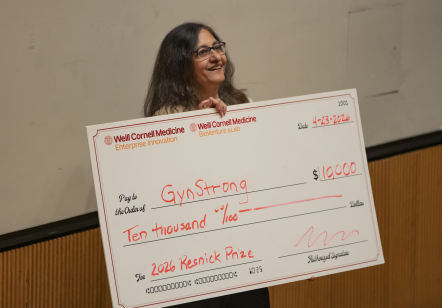
GynStrong CEO Dr. Johanna Ali accepting the prize check.
Dr. Amir Goldan, associate professor of electrical engineering in radiology at Weill Cornell Medicine, presented NeuroTwain, a virtual ocular-motor screening tool for neurodegenerative diseases. NeuroTwain uses an augmented-reality headset and immersive tasks paired with physiological tracking to screen patients for early-stage neurodegenerative diseases, such as Alzheimer’s and Parkinson’s.
“Scalability is the key to our mission to not only democratize screening of brain disorders, but also give people control over their brain health,” Dr. Goldan said.
The 2026 Susan and Gene D. Resnick ’70, MD ’74 Prize for Excellence in Entrepreneurship, which recognizes cross-campus Cornell research or clinical collaborations, went to GynStrong — developer of the Tamicap, a non-invasive, drug-free device that uses neuromodulation to treat chronic pelvic pain.
“One in three women has pelvic pain. The medicines for it are largely ineffective and have side effects. At GynStrong we believe women deserve better,” said Dr. Tamatha Fenster, inventor of the Tamicap and an assistant professor of clinical obstetrics and gynecology at Weill Cornell Medicine.
AI’s Value with Both Mundane and Impossible Tasks
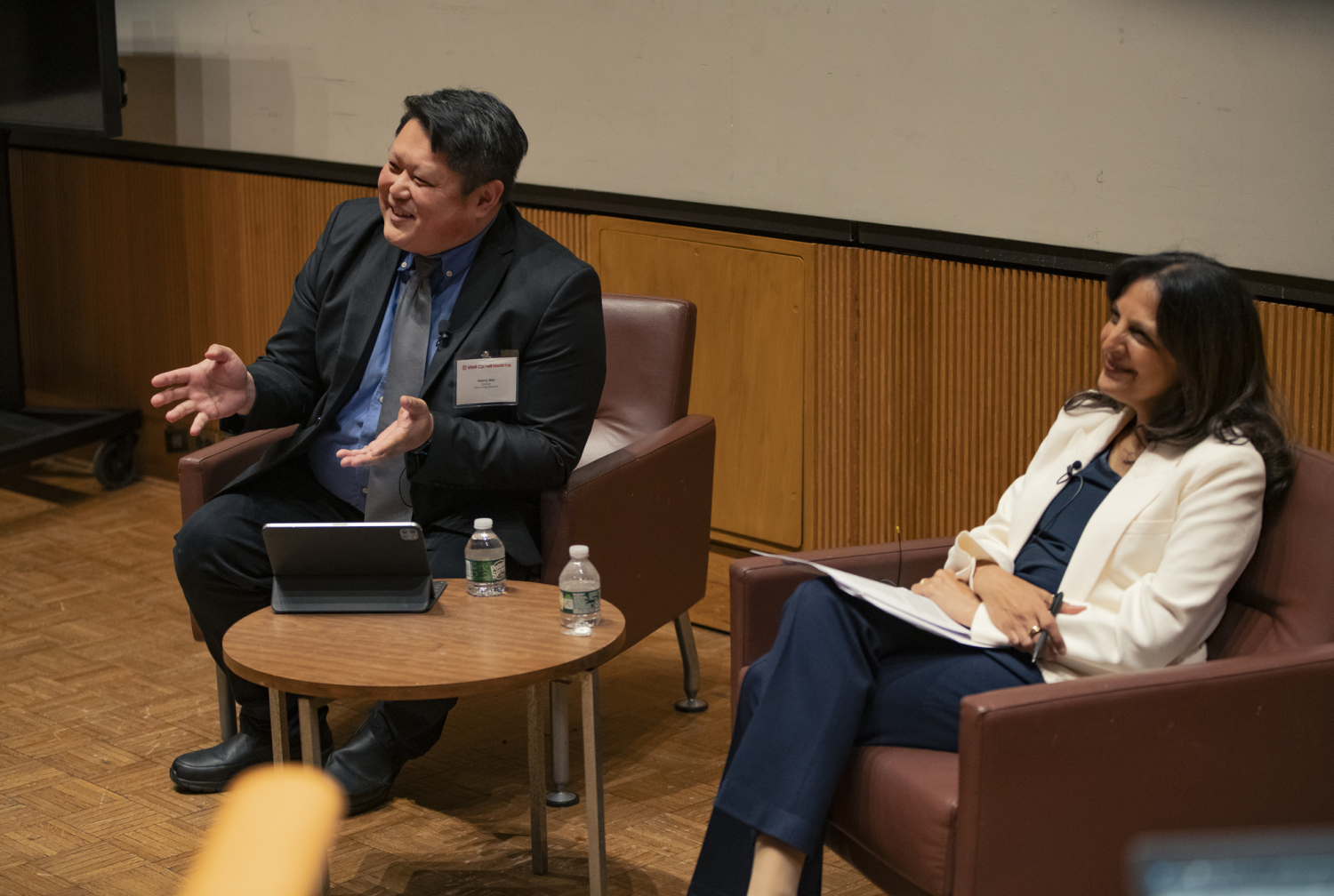
Dr. Rainu Kaushal, senior associate dean of health data science at Weill Cornell Medicine, led a fireside chat examining the intersection of AI and innovation with Dr. Henry Wei ’02, executive director of development innovation at Regeneron.
Dr. Wei considered two ends of the spectrum of useful work amenable to AI in clinical drug development. The first is the work humans can do, but don’t like to do. “I think, the biggest opportunities are largely mundane — the parts that people don’t like,” he said, comparing AI to robotic vacuums that took off in popularity by handling work most people find tedious.
He pointed to electronic health records as an example. Data points like ejection fraction, a cardiac measurement, were once challenging to find in patient charts because they live as unstructured information. With generative AI, he said, extracting that kind of information is now much easier.
The second is work humans can’t easily do, or can’t do at all. AI’s other strength, Dr. Wei said, lies in “understanding the variety of data, interpreting them and incorporating them into things like biostatistical study design” — synthesizing across datasets too large or too varied for any individual to hold in mind.
Between those two ends, he cautioned against forcing AI into everyday work and suggested that researchers ask where AI is most useful in the process.
Investing in Standardized and Scalable Drug Development
Dr. Michael Foley, CEO and co-founder of Excelsior Sciences, was joined by Cornell University alumnus Adam Volini, executive director and vice president for life sciences and strategic partnerships at New York State Empire State Development for a panel on drug development.
Dr. Foley pointed out only about 2,000 small-molecule drugs have ever been approved by the FDA, noting that small-molecule drug discovery moves too slowly and the process of making new ones has remained “largely artisanal for 200 years.”
“There’s this huge chemistry bottleneck,” he said.

Adam Volini (left) and Dr. Michael Foley.
Excelsior is his attempt to change that with the concept of modularity. The company’s platform pairs modular chemistry — building new molecules from prefabricated blocks derived from FDA-approved drugs — with the standardized, full-matrix data that AI models need to predict molecular properties.
“What we’re doing is embracing modularity in the service of chemistry in a way that couldn’t be done before,” Dr. Foley said, championing this drug-discovery approach and noting that the stakes extend beyond any single company.
He also pointed to the advantages of reshoring drug manufacturing, saying it’s a $500 billion public investment opportunity in the United States. Excelsior itself exists, Dr. Foley said, because an Empire State Development grant let the company build its infrastructure, an example of the value of public investment.
Volini discussed an “ecosystem problem,” one which New York state is helping to solve by investing in cell and gene therapy manufacturing, GPU computing for university researchers, and proposed commercialization grants focused on neurodegeneration.
“What the state’s really good at is convening the brightest people in the room and giving them the space and the resources to experiment and do what they do really well,” said Volini.
When an attendee asked how a therapeutic platform company can assess product market fit and broader economic impact, Volini brought it back to scalability.
“If you’re not thinking about your manufacturing scalability and your cost of goods sold very early on in your discovery process, you may come up with a really great product that can do great things, but we can’t make it at scale and that’s not efficient,” he said. Volini advised that anyone thinking about commercializing a technology must have a successful business model behind it.
“Bringing together academic innovators, industry leaders and the investment community is essential to advancing discoveries into products that help patients,” said Busby. “What distinguishes this conference is that participants experience firsthand the culture of collaboration and the momentum of our expanding research and clinical footprint. It reflects Weill Cornell Medicine’s leadership in building an innovation ecosystem that can effectively commercialize innovations and spin out startups with staying power.”