
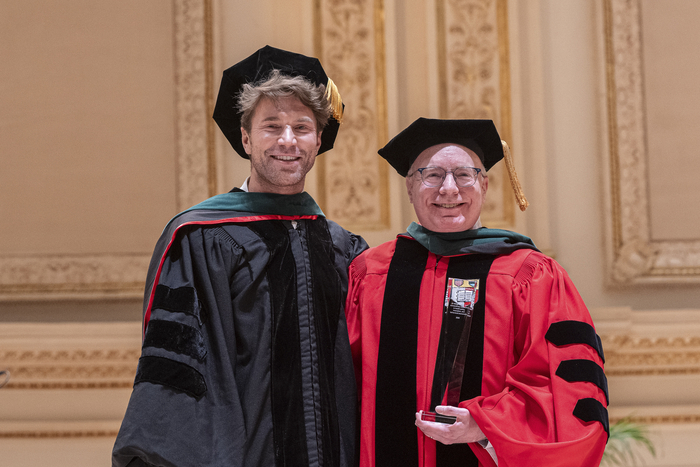
Dr. David Asch (M.D. ’84), senior vice president for strategic initiatives at the University of Pennsylvania and the John Morgan Professor at the University of Pennsylvania’s Perelman School of Medicine and the Wharton School, has been awarded the 2026 Weill Cornell Medical College Alumni Association Award of Distinction.
Established in 1949, the award is presented each year to a Weill Cornell Medical College alumnus who has demonstrated exceptional achievement in education, research or patient care, and who has brought honor and acclaim to the institution.
Dr. Asch received the award on May 14 at Weill Cornell Medicine’s 2026 commencement ceremony in recognition of his distinguished career combining economics, psychology and marketing, in the field now called behavioral economics, to deepen understanding of medical decision-making and inform healthcare policy.
“Behavioral economics is about how you design interactions that accommodate, reflect and amplify the behaviors we naturally have,” says Dr. Asch. “When thoughtfully applied, and tested with rigor, principles of behavioral economics can improve the experience for clinicians and the outcomes for patients.”
Drawing on his training at Weill Cornell Medical College and residency in internal medicine at the University of Pennsylvania, Dr. Asch has focused on how medical decisions are made by patients, clinicians and policymakers, and how they can be improved.
His early research included studies examining the ethical challenges clinicians face in intensive care, work that helped inform Supreme Court decisions on end-of-life care in the 1990s. He has also explored the clinical, economic and ethical consequences of genetic testing for cystic fibrosis and BRCA mutations, contributing to policy discussions that led to the Genetic Information Nondiscrimination Act of 2008.
Dr. Asch continues to apply behavioral economics to medicine by using financial incentives, social influence and digital “nudges” to encourage medication adherence, weight loss and fitness.
Dr. Asch’s leadership at the University of Pennsylvania has helped influence national efforts to evaluate medical training programs based on patient outcomes rather than traditional academic benchmarks.
He spent more than 30 years with the U.S. Department of Veterans Affairs, where he developed a research program focused on health equity.
His unique approach was shaped by his medical school mentors. “Many of the faculty mentors I had at Weill Cornell were institutional legends for a reason,” says Dr. Asch.
He credits his medical school professor Dr. Martin Gardy (M.D. ‘60) as “the person who awakened me to the importance of medical judgment” shaping his lifelong focus on how the behavior of patients and clinicians interacts with medicine.
“The final common pathway of nearly all medical advances and outcomes is behavioral,” he says. “You can develop a great treatment or a great preventive intervention, but you only achieve value if physicians prescribe it and patients accept it.”
His interest in human behavior was also influenced in part by his late father, Dr. Stuart S. Asch, a professor of clinical psychiatry at Weill Cornell Medicine, who taught the second-year psychiatry course to his classmates.
Outside of his work, Dr. Asch describes a life grounded by his family, his wife of nearly 40 years, their two children and two grandchildren. He maintains strong bonds with former classmates. “We develop enduring relationships throughout our training. I didn’t predict how important my medical school cohort would become for me, but that’s the group I have on speed dial.”